Wednesday, January 30, 2013

Brewers' Profile #02: Uzenshiraume (Haneda shuzo)


picture from "www.rakuten.co.jp/e-vin"
 
  In the past there were more than 40 breweries in the Oyama area, Yamagata Pref., but now only four remain. The oldest of these, Uzenshiraume, established in 1592, is located in Tsuruoka city. Using traditional tools the brewers take great care making their Sake bottle by bottle, and consequently they only produce 54kl a year.

  They make a powerful Koji and use no carbon filtration but their Sake is still clean and fresh.

  At first sip you may feel no great impact however you never get tired of drinking Uzenshiraume.

  I also enjoy eating Tsuruoka ramen and browsing in the antique shops every time I visit Uzenshiraume.

Monday, January 28, 2013

Brewers' Profile #01: Koikawa shuzo


  Established mid 18th century, Koikawa produces approx. 140kl using Dewa sansan, Miyamanishiki and Gohyakumangoku rice strains, among others and has worked energetically to brew from locally produced brewers’ rice except for Yamadanishiki which comes from Tokushima Pref.
  Since 1981 Koikawa has also used the rice Kame-no-o -- a very old brewers’ rice that can only be grown using organic methods. Koikawa's Daiginjo Abekameji using Kame-no-o won a gold prize at 2008 Tohoku Sake contest -- an unprecendented achievement for this particular rice. Today Kame-no-o rice is grown by 8 selected farms in Shonaicho, where Koikawa is situated.

  If you visit Koikawa you can enjoy another delicious experience. Not far from Koikawa is Al-che-cciano, one of the best Italian restaurants in the Tohoku region. Here you can enjoy the very best of Italian cuisine with Koikawa sake. 

Saturday, January 12, 2013

Happy New Year !

We wish you all the best to 2013.

P.S.
I enjoyed my new year Sake, the last bottle of "Taketsuru Ozasaya Daiwa-omachi 16BY (2004)". It was amazingly smooth and tasty.
* Our current stock of this Sake is 17BY (2005) or later.


Thursday, November 22, 2012

720ml and 500ml sake available now!

Here is our 720ml and 500ml sake list including the new items we received this month.

The delivery cost to addresses in Sydney metropolitan area is $15.00 (flat rate).To the rest of Australia, please check by using our shipping cost estimator on our online shopping cart.

For the details of each sake, please click the picture.


Junmai Daiginjo :


Junmai Ginjo :


Junmai :


Junmai Koshu (Aged sake) :


Junmai Nama (Unpasteurized sake) :


Junmai Umeshu (Plum wine) :


Saturday, October 13, 2012

Izumibashi-shuzo

I visited 'Izumibashi-shuzo' in Kanagawa on 6th September.

Izumibashi says that sake brewing includes rice farming.  Izumibashi have their own rice field and they also get some rice from farmers in the area who they have built a very close relationship with.

When I visited them, the Kamenoo rice was almost ready for harvesting. The others, Yamadanishiki and Omachi, were still young. Kamenoo's origin is Tohoku. So Kamenoo grows earlier in Kanagawa, then Yamadanishiki (Hyogo) and Omachi (Okayama) grow later. It was very interesting to see the rice with different origins all at the same time.

They do not use chemical fertilizers or agricultural chemicals on most of their rice.

Recently many breweries use organic or organically grown rice for their sake. Organic farming is good for our environment and our health. But the main reason of using organic rice is much simpler. They can make really good sake by using these rice.

 Kamenoo rice.

 The white long bristles are the Kamonoo's trademark.
The bristles make the beautiful color of 'Nishiki-iro'.

 Yamadanishiki rice.

 Omachi rice.

 Yamadanishiki (left) is much taller than Omachi (right).

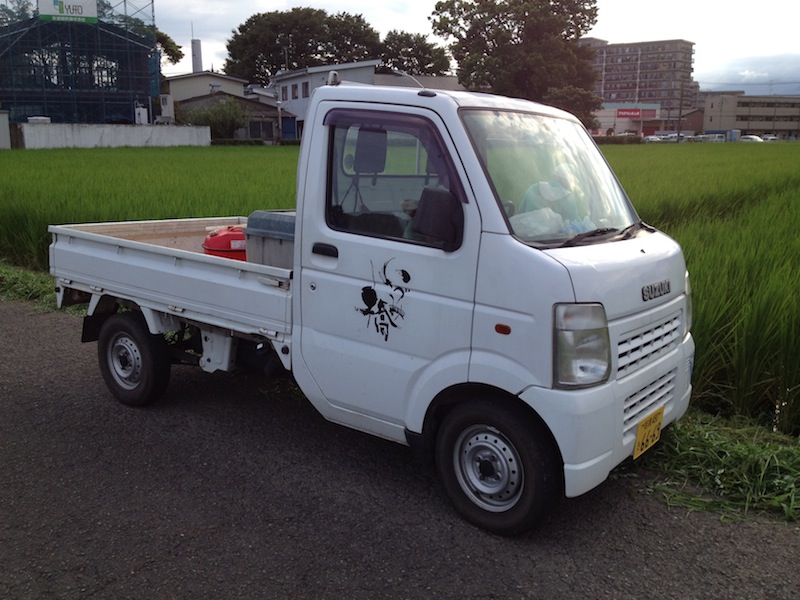
 A Japanese ute with the Izumibashi-mark (under 600cc engine).
 A huge rice polishing machine.

 His new machine!

 They used to use this boat when there was flooding (a long time ago).

Tuesday, October 9, 2012

Monday, October 1, 2012

My visit to Shinkame

On 31st August, I (Taka) visited a brewery 'Shinkame-shuzo' in Saitama. 

In 1987 this brewery became the first to change to producing only Junmaishu. This was an epoch-making event. The brewers' emphasis was on ageing the sake.

Breweries make sake in winter, so I could not see the sake making process. However I got  some interesting things from this visit.

This summer in Japan was really hot. Over 30˚C outside everyday.

A big beetle in the backyard. This beetle is a symbol of summer in Japan.

At the office, his favorite cat クララ (Clara) is happy in her box.

Shinkame sake ageing in the sake tanks.

This is the cold ageing room (-10˚C). Daiginjo & Ginjo sake is in this room for couple years.

The top of the sake fermentation tanks.

They use these parts on top of the tanks. So there is no chance the workers will fall into the large tanks.

These tanks are for the middle brewing stage between the yeast starter and the main mush. I haven't seen these middle size tanks at other breweries, but Mr Ogawahara says everyone used to use them a long time ago. The temperature control is easy by using these tanks.

Return to the office, Mr. Ogawahara is happy with his favorite cat, クララ (Clara).

The 'Shinkame shop' next to the brewery building.

They have a good selection of sake (Of course!).